
Magtein® vs. Magnesium Glycinate: Magtein Shown in Research to Reach the Brain — Backed by 40+ Published Studies
Around one-third of the world’s population doesn’t get enough magnesium each day, and the consequences quietly show up in energy, sleep, mood, stress, and cognitive performance.(Passarelli) Magnesium is essential for over 600 enzymatic reactions and plays key functional, and neurological roles in the body. It supports energy production, protein synthesis, DNA processing, nerve signaling, and normal muscle contraction and relaxation.(Baaji) But when it comes to brain-powered functions such as learning, memory, mood, focus, heart rate variability, and sleep quality, not all forms of magnesium work the same way. What truly matters is whether the magnesium can effectively reach the brain, cross the blood–brain barrier, and raise neuronal magnesium levels, a capability demonstrated by Magtein® (magnesium L-threonate) and supported by both scientific research and clinical research.
Magnesium supplementation products are available in several forms such as oxide, citrate, malate, taurate, sulfate, chloride, glycinate, and Magtein (magnesium L-threonate). Two of the most widely used forms are magnesium glycinate and Magtein (magnesium L-threonate), and both help maintain healthy magnesium levels in the body. However, Magtein (magnesium l-threonate) has form-specific research connecting it to overall cognitive health, memory, focus, and sleep quality.*
Why Magnesium Form Matters
A supplement label tells you how much magnesium a product contains, but not how effectively that magnesium is digested and absorbed, or where it goes once inside the body.
Glycinate vs Bisglycinate vs Buffered Forms: Do You Know What’s in Your Magnesium?
There are many variations of magnesium glycinate on the market, and they are not all equal in quality or absorption. Several products are buffered with magnesium oxide (MgO) — a form known to have very low bioavailability — simply to increase the elemental magnesium content on the label. This can mislead consumers, as the added MgO does not improve absorption and may cause gut discomfort in higher doses.
Other products use different chelation ratios, blends, or partial glycinates, creating significant variability in purity, absorption, and effectiveness. Because of these inconsistencies, the performance of “magnesium glycinate” can differ widely between brands.
In contrast, Magtein consists of one specific, well-defined form: magnesium L-threonate. It is clinically validated, used consistently across all human and preclinical studies, and supported by a robust, evidence-based dose range. Every published study on Magtein has used this same patented form, ensuring consistency, reliability, and reproducibility of results.
Magtein (magnesium L-threonate)
Magtein is a unique form of magnesium created by researchers at leading universities and neuroscientists to help magnesium reach the brain more effectively.* The threonate in magnesium l-threonate is a natural byproduct of vitamin C. When magnesium is bonded to L-threonic acid, it forms magnesium L -threonate.
The threonate component matters because it helps magnesium:
- L-threonate binds magnesium, forming a stable Magtein complex.
- Dissolve easily in the body*
- Reach the brain more effectively*
- Enter the brain cells*
- Enhance memory & learning*
- Support Sleep, mood, and healthy brain cognitive aging*
- Improve Heart Rate Variability*
Magtein is the same well-defined form of magnesium L-threonate that has been used consistently, across both human and preclinical research. The same ingredient, the same structure, and the same scientifically supported dose range are used each time. That level of consistency gives Magtein a strong, reliable evidence base and reproducible results.
To ensure you’re getting the same ingredient used in the research, look for the Magtein name and its swirl logo on the label. These symbols confirm that the product contains the clinically validated form studied in published research, with predictable quality and a clear, well-defined scientific profile.
What the Evidence Shows About Magnesium
Glycinate Magnesium glycinate is widely used for relaxation and general well-being, but clinical data specifically linking glycinate to sleep or brain health outcomes are limited.
Despite widespread use and marketing, many of these forms lack robust, well-controlled human clinical studies to substantiate specific health benefits or support strong structure–function claims. In most cases, benefits are extrapolated from magnesium’s general role in the body rather than demonstrated for the specific form itself. This creates a gap between label claims and clinically validated outcomes.
In addition, forms such as magnesium glycinate or bisglycinate, some perceived benefits—particularly around relaxation and sleep—may be partly attributed to the glycine ligand rather than magnesium itself. Glycine is a known inhibitory neurotransmitter that can promote calmness and support sleep quality. As a result, the observed effects may not reflect the unique performance of the magnesium form, but rather the physiological role of glycine, further complicating interpretation of efficacy and claims.
- Major reviews on magnesium and sleep include mixed forms of magnesium, not glycinate alone (Cao et al., 2021).
- No randomized controlled trials have demonstrated that magnesium glycinate specifically improves sleep quality, cognition, or mood in healthy adults.
- In randomized controlled trials (RCTs) suggesting benefit, insomnia trials have mainly used magnesium oxide or citrate (Mah J.)
Summary: Magnesium glycinate is a magnesium form for maintaining magnesium intake, but form-specific evidence for brain or sleep benefits are not clinically established.
How Magtein Goes Further
Magtein leverages magnesium’s essential biological role and is specifically designed to deliver it where it matters most—the brain. By crossing the blood–brain barrier and increasing neuronal magnesium levels, it supports cognitive function, including benefits for cognition, sleep, and focus.
Developed to address the challenge of brain delivery, Magtein (magnesium L-threonate) uses its L-threonate component as a carrier to facilitate magnesium transport into the brain, where it supports healthy neural communication and energy metabolism. (Liu et al., 2010; Zhou & Liu, 2015).*
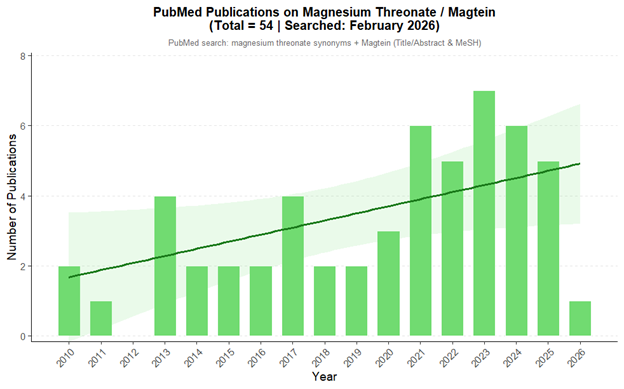
There have been 30+ peer-reviewed publications involving magnesium L-threonate since 2010, suggesting it is widely used in academic research and trusted as a source of magnesium for brain-health studies.
Research Overview
Preclinical and clinical studies have explored how magnesium L-threonate supports brain magnesium levels, cognitive function and sleep quality.*
| Study | Participants | Duration | Focus Area | Key Finding* |
| Liu et al., 2016 | Adults 50–70 yrs | 12 weeks | Memory & focus | Supported improved composite cognitive scores |
| Xu et al., 2016 | Animal + cell models | — | Learning & plasticity | Mechanism of action: Increased brain magnesium and synaptic density |
| Hewlings & Kalman, 2022 | Adults 50–70 yrs | 12 weeks | Mood & stress | Supported improved emotional well-being |
| Zhang et al., 2022 | Adults 18–65 yrs | 30 days | Learning & recall | Supported clearer thinking and recall |
| Hausenblas et al., 2024 | Adults 35–55 yrs | 21 days | Sleep & alertness | Supported deeper sleep and better morning focus |
| Lopresti et al., 2026 | 100 adults 18–45 yrs | 6 weeks | Cognition, sleep & heart health | Improved cognition (7.5-yr reduction in cognitive age), lower HR, higher HRV, better subjective sleep |
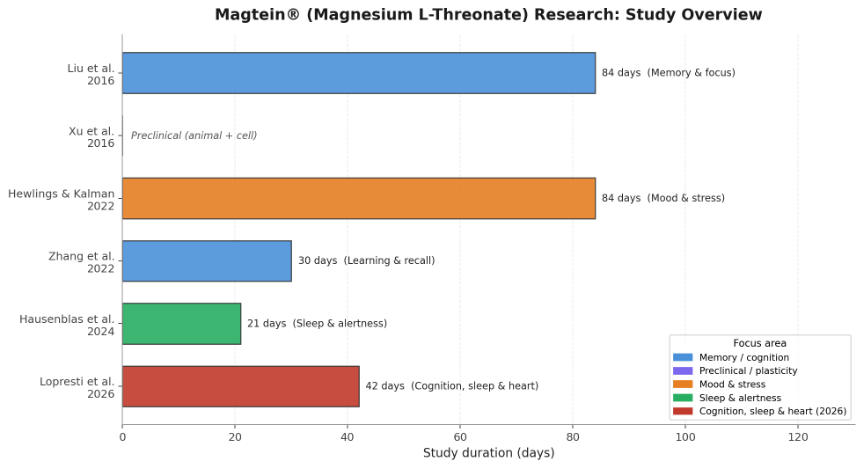
Figure 1. Magtein® (magnesium L-threonate) studies by duration and focus area (2016–2026).
Comparing the Two Forms
| Feature | Magnesium Glycinate | Magtein (Magnesium L-Threonate) |
| Absorbed where | Body | Body and brain |
| Crosses blood–brain barrier | Limited evidence | Supported by several published research (Liu et al., 2010) |
| Main benefits | Relaxation (glycine-dependent) and magnesium balance* | Supports cognitive function, and sleep quality (brain magnesium support) * |
| Research base | Limited form-specific studies | 30 + peer-reviewed publications, 9 human trials |
Both forms help maintain healthy magnesium levels, but Magtein offers additional, well-researched support for brain-related outcomes.*
Sleep, Productivity, and Cognitive Support
In a 21-day double-blind trial, participants taking magnesium L-threonate showed improvements in deep and REM sleep and better morning focus, mood, and next day productivity, compared with placebo (Hausenblas et al., 2024).*
In a 6-week randomized, double-blind, placebo-controlled trial, adults taking magnesium L-threonate (Magtein®) showed significant improvements in overall cognitive performance, including working memory and reaction time, along with a reduction in estimated brain age (~7.5 years vs placebo). Participants also reported improvements in sleep-related impairment, with additional physiological benefits such as reduced resting heart rate and increased heart rate variability during sleep—markers linked to better recovery and stress balance (add the 2026 study citation)
Magtein (magnesium L-threonate) is the only form of magnesium with a brain-health mechanism directly tied to its L-threonate component—supporting structural and functional changes in the brain, including increased synaptic density, improved neuronal signaling, and enhanced neuroplasticity, which may help explain its superior cognitive and sleep benefits. Consistent with this, additional studies link magnesium L-threonate to memory and learning support through its influence on synaptic density and neuronal signaling (Xu et al., 2016; Zhou & Liu, 2015).
No comparable, glycinate-specific evidence has been published to date.
The Takeaway
Not all magnesium supplements are created equal. Many supplement products boost “elemental magnesium” on the label by using poorly absorbed magnesium oxide (MgO), which can limit real-world benefits. And while magnesium glycinate is a popular choice, it has limited clinical research for sleep and no clinical evidence for cognition compared with magnesium L-threonate—making magnesium L-threonate the more evidence-backed option when your goal is brain and sleep support. Magtein is a unique magnesium form that helps magnesium reach the brain to support focus, calm, and healthy cognitive aging — combining broad magnesium benefits with brain-targeted science.*
These statements have not been evaluated by the Food and Drug Administration. This product is not intended to diagnose, treat, cure, or prevent any disease.*
References
- (1)(Passarelli S, Free CM, Shepon A, Beal T, Batis C, Golden CD. Global estimation of dietary micronutrient inadequacies: a modelling analysis. Lancet Glob Health. 2024;12(10):e1590-e1599. doi:10.1016/S2214-109X(24)00276-6.
- de Baaij JHF, Hoenderop JG, Bindels RJ. Magnesium in man: implications for health and disease. Physiol Rev.2015;95(1):1-46. doi:10.1152/physrev.00012.2014.
- Volpe S. L. (2013). Advances in Nutrition, 4(3), 378S–383S.
- Costello R. B. et al. (2016). Advances in Nutrition, 7(3), 505–513.
- Walker A. F. et al. (2003). Magnesium Research, 16(3), 183–191.
- Rosanoff A. et al. (2021). Nutrients, 13(6), 1847.
- Cao C. et al. (2021). Nutrients, 13(12), 4293.
- Liu G. et al. (2010). Neuron, 65(2), 165–177.
- Mah J, Pitre T. Oral magnesium supplementation for insomnia in older adults: a systematic review and meta-analysis. BMC Complement Med Ther. 2021;21:125. doi:10.1186/s12906-021-03297-z.
- Xu Z. et al. (2016). Scientific Reports, 6, 35035.
- Zhou H., & Liu G. (2015). Molecular Brain, 8(1), 23.
- Zhou H. et al. (2024). Nature Communications, 15(2), 4481.
- Hewlings S., & Kalman D. (2022). EC Nutrition, 17(4), 74–81.
- Zhang C. et al. (2022). Nutrients, 14(11), 2301.
- Hausenblas H. et al. (2024). Sleep Medicine X, 7, 100128.
- Lopresti AL, Smith SJ, Ferguson D, Drummond PD. The effects of magnesium L-threonate (Magtein®) on cognitive performance and sleep quality in adults: a randomised, double-blind, placebo-controlled trial. Front Nutr. 2026;12:1729164. doi:10.3389/fnut.2025.1729164.